DISCOVER THE SOLUTION — SHOP NOW
You Used to Wake Up Ready. Now You Wake Up Already Exhausted.
Why coffee stopped working and 8 hours of sleep feels like 3

By Dr. Maria Caldwell | April 15, 2026

The alarm goes off at 6am.
You've been awake since 3:47am.
You drag yourself out of bed feeling like you were hit by a truck. Make coffee. Drink coffee. Wait for the caffeine to kick in.
It doesn't.
By 10am you've had three cups and you still feel like you're moving through wet concrete.
This is my Tuesday. And my Wednesday. And every other day for the past eight months.
"Just sleep better," they say. "Try melatonin. Go to bed earlier. Cut out screens."
I've tried everything. I go to bed at 9:30pm. I fall asleep fine. Then I wake up at 3am like someone flipped a switch, heart racing, mind spinning, and I know with absolute certainty I will not fall back asleep.

What Your Doctor Didn't Tell You About the 3AM Wake-Up
Here's what nobody explained until I'd wasted $600 on sleep studies and supplements:
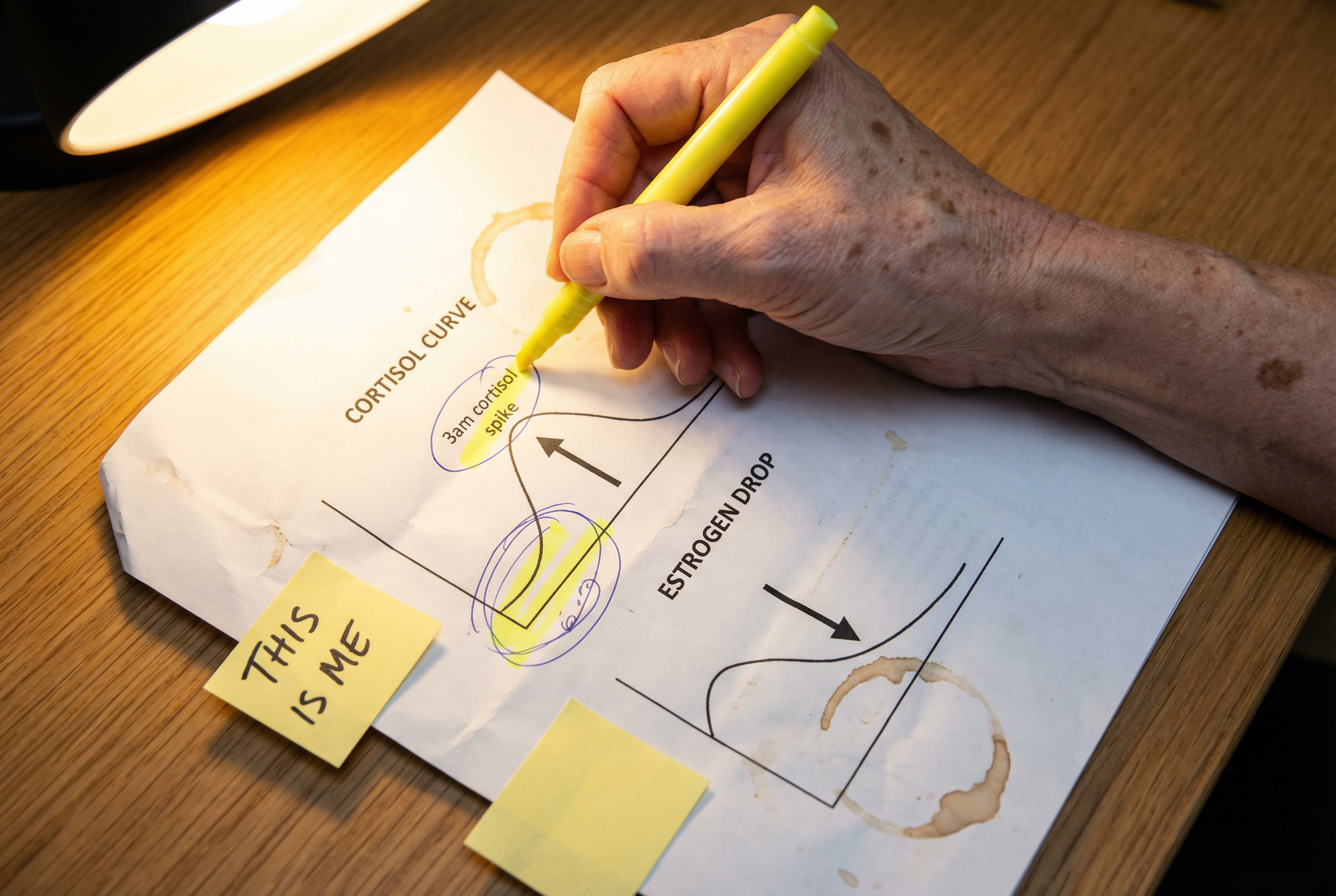
The 3am wake-up isn't insomnia. It's your cortisol trying to save you.
When you fall asleep around 10pm, your estrogen starts to drop as part of the natural nighttime rhythm. In a normal hormonal environment, this is fine. Your body compensates smoothly.
But in perimenopause, your estrogen doesn't just drop — it crashes.
Your body perceives this sudden estrogen crash as an emergency. So it does what it's designed to do: it floods you with cortisol to stabilize blood sugar and keep you alive.
Cortisol is your "wake up and run from the tiger" hormone. Which is why you wake up at 3am wired, anxious, heart racing, and completely unable to fall back asleep.
You're not broken. Your HPA axis is doing exactly what it's supposed to do when hormones crash.
Why You Feel Exhausted Even After 8 Hours
"But I slept from 10pm to 6am. That's eight hours. Why do I feel worse than when I pulled all-nighters in college?"
Because estrogen doesn't just control your reproductive system. It controls your mitochondria.
Mitochondria are the power plants in every cell of your body. They make ATP — cellular energy. The stuff that lets you think, move, exist.
Estrogen tells your mitochondria to make ATP efficiently.
When estrogen crashes (which it does multiple times per cycle in perimenopause), your mitochondria slow down. You make less ATP. You have less cellular energy.
This is why coffee stops working. Caffeine can't create energy that your cells aren't producing in the first place.

The Kitchen Paralysis Nobody Talks About
I stood in front of my coffee maker for five full minutes yesterday morning.
Not because I was thinking about something else. Because I genuinely could not remember the steps to make coffee.
Water. Filter. Coffee grounds. Button.
My brain knew the words but couldn't connect them to actions.
This is what happens when your brain cells don't have enough energy to function. It's not depression. It's not early dementia. It's your neurons literally not having enough ATP to fire properly.
The brain fog, the memory issues, the standing in rooms forgetting why you walked in there — all of it comes back to mitochondrial function crashing when estrogen crashes.

What Actually Works (And Why Everything Else Failed)
I tried melatonin. Made me groggy but didn't stop the 3am wake-ups.
I tried magnesium. Helped for two weeks, then stopped working.
I tried ashwagandha. Made me feel flat and disconnected.
I tried going to bed at 9pm. Still woke up at 3am, just with more hours of lying awake.
Nothing worked because I was treating symptoms, not the mechanism.
The mechanism is this: Your cortisol is spiking because your estrogen is crashing, and your mitochondria can't produce energy because estrogen isn't stable.
You can't melatonin your way out of a cortisol spike. You can't magnesium your way out of mitochondrial dysfunction.

The Women Who Sleep Through the Night Again
"I haven't slept past 4am in two years. TWO YEARS. Within three weeks of supporting my cortisol regulation properly, I slept until 6:30am. I actually cried when I woke up and saw the time."
— Lisa M., 46
"The brain fog was so bad I couldn't follow conversations at work. My boss asked if I was okay. Supporting mitochondrial function brought my brain back online. I can think again."
— Deborah K., 43
"I was drinking four cups of coffee by noon and still falling asleep at my desk. Once my cellular energy production stabilized, I cut back to one cup and actually have energy all day."
— Sharon P., 50

What Changed When I Fixed the Mechanism
It's been three months since I started supporting my HPA axis properly instead of just taking random sleep supplements.
I still wake up some nights at 3am. But it's twice a month instead of fourteen times.
When I do wake up, I fall back asleep within twenty minutes instead of lying there until dawn.
I wake up at 6am when my alarm goes off and I don't feel like I need a forklift to get out of bed.
I made coffee this morning and my brain knew what to do with the coffee maker.
I'm not bouncing off the walls with energy. But I can get through a workday without wanting to cry from exhaustion by 2pm.

If Coffee Stopped Working and Sleep Doesn't Restore You
The exhaustion isn't in your head.
The 3am wake-ups aren't "just stress."
The brain fog isn't early dementia.
Your HPA axis is dysregulated because your estrogen is crashing multiple times per cycle, triggering cortisol spikes that destroy your sleep and tank your cellular energy production.
You can't supplement your way out of this with magnesium and melatonin. You have to address the cortisol-estrogen cascade at the source.

The protocol that restored my sleep and energy is called RYVIVE™ — it's the only supplement I found that targets HPA axis regulation and mitochondrial support simultaneously instead of just throwing melatonin at the problem.
I'm sharing this because I wasted two years and over $2,000 trying everything else. If you're waking up at 3am exhausted before your day even starts, you don't have two years to waste.
Free shipping · 60-day money back guarantee