DISCOVER THE SOLUTION — SHOP NOW
I Watched My Sister Disappear. I Built RYVIVE to Bring Her Back.
Why rage and numbness aren't opposites — and the one thing that controls both

By Lauren Hayes, Founder of RYVIVE | April 15, 2026

My sister Claire, 37. This is what I walked in on.
I walked into my sister Claire's house on a Sunday afternoon in October 2024 and found her sitting on the couch in the same sweatpants she'd been wearing for three days.
The TV was on. Her kids were somewhere in the house. Her husband was in the kitchen. And Claire was just... sitting there. Staring at nothing. Not sad, not tired, not angry. Just completely empty.
I sat down next to her and said her name. She looked at me like she was looking through me.
"I don't feel anything," she said. "I haven't felt anything in weeks."
"I used to cry at movies. I used to get excited about things. Now I feel nothing — and the worst part is I don't even care that I feel nothing."
I want to be honest about what made this so frightening. It wasn't just the numbness. It was the fact that three weeks earlier, Claire had been the opposite of numb.
She'd been screaming. Not at anything in particular. At her kids for leaving shoes in the hallway. At her husband for asking what was for dinner. At herself for being unable to stop. She'd called me in tears one night saying she didn't recognize herself, that she'd said things to her daughter she couldn't take back, that she felt like a monster living inside her own body.
And then, almost overnight, the rage just... stopped. And nothing replaced it. Not calm. Not peace. Just a flat, grey nothing that was somehow worse than the anger.
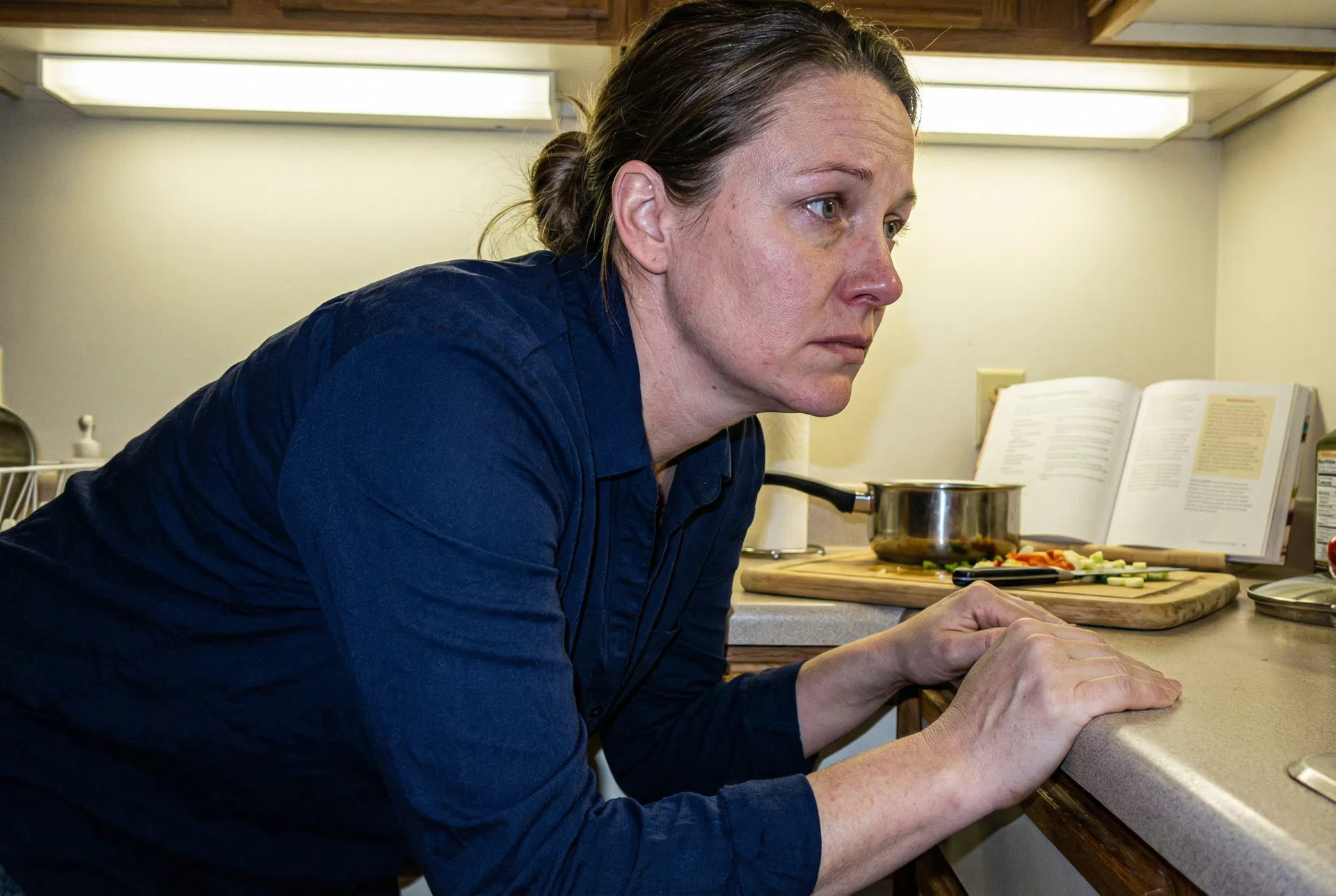
Her Doctor Said She Was "A Little Stressed"
Claire had been to her GP twice. Both times she'd left with a leaflet about mindfulness and a suggestion to "reduce her stress load." Her labs were normal. Her thyroid was fine. She wasn't depressed — at least not in any way that showed up on a questionnaire.
She was 37. Her doctor didn't mention perimenopause. Claire didn't ask about it because, like most women her age, she thought perimenopause meant hot flashes and irregular periods. She had neither. So it couldn't be that.
What she had was rage that came from nowhere and disappeared into numbness. A complete inability to feel joy, excitement, or love the way she used to. And a creeping, terrifying sense that the person she had been was gone, and nobody could tell her where she went.
"I kept waiting for the rage to come back because at least when I was angry I knew I was still in there somewhere. The nothing was worse. The nothing felt permanent."
— Claire, 37 — my sister
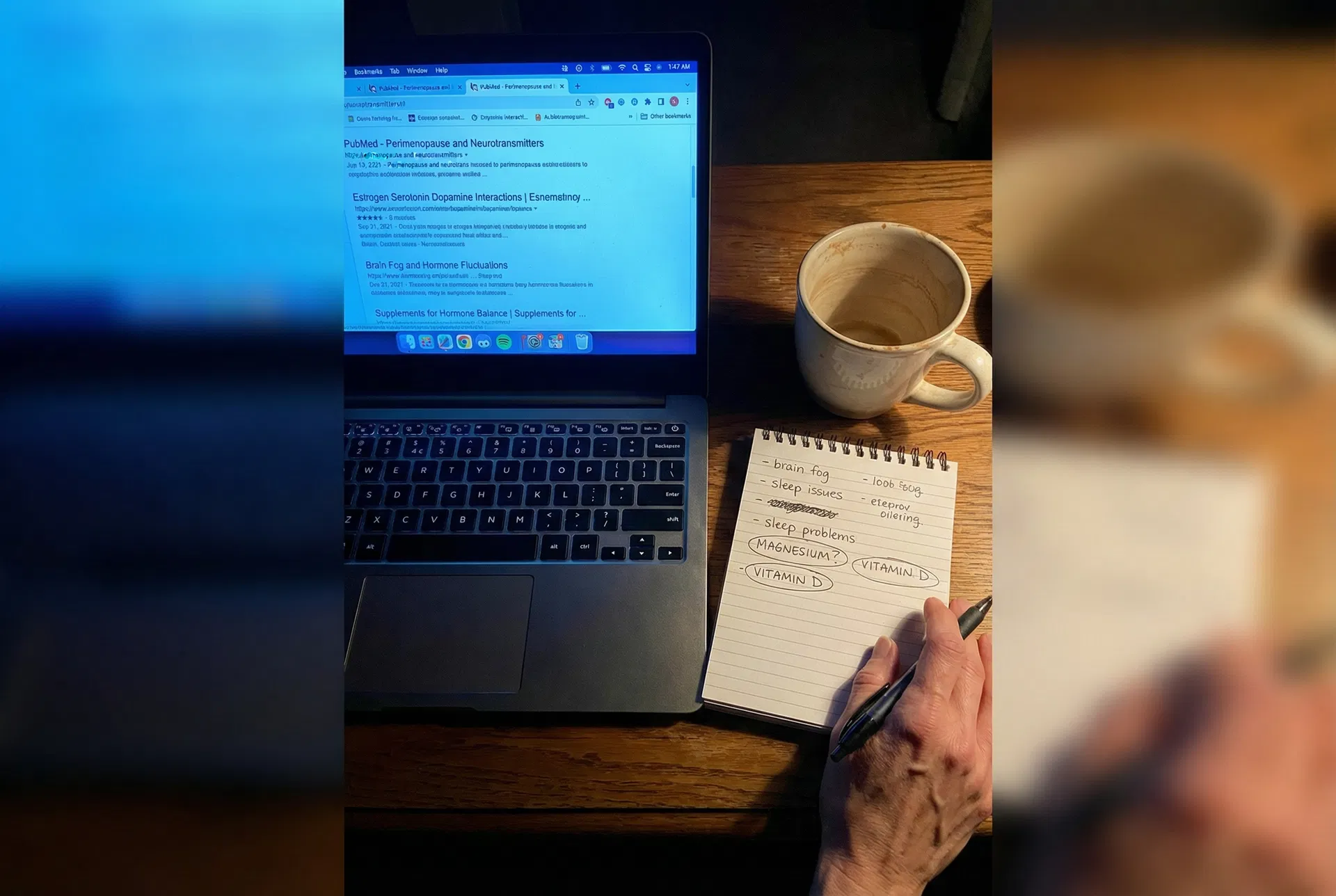
I Spent Six Months Reading Every Study I Could Find
I'm not a doctor. I have a background in biochemistry and I'd spent a decade in the nutraceutical industry, but I want to be clear: I didn't go into this with answers. I went into it with a laptop, a terrible sleep schedule, and a sister who needed me to figure something out.
What I found changed everything I thought I understood about perimenopause.
Most people — including most doctors — think of perimenopause as a gradual estrogen decline. Levels drop slowly over years, symptoms appear gradually, you manage them. That's the textbook version.
The reality, according to the research I was reading at 1am on a Tuesday, is completely different. In perimenopause, estrogen doesn't decline steadily. It fluctuates wildly — spiking and crashing multiple times within a single cycle, sometimes swinging 600% in 48 hours.
And here's what nobody tells you: estrogen is the primary regulator of both serotonin and dopamine production in the female brain.
Serotonin controls emotional regulation — your ability to stay calm, to not snap, to feel stable. Dopamine controls your ability to feel pleasure, motivation, and joy.
When estrogen crashes, both systems crash with it. Simultaneously. Which means the rage and the numbness aren't two different problems. They're the same problem — the same broken neurochemical system — expressing itself in two different ways depending on which neurotransmitter is most depleted at any given moment.
The rage is low serotonin. The numbness is low dopamine. The whiplash between them is your estrogen fluctuating so rapidly that your brain can't stabilize either system long enough to feel like yourself.
Claire wasn't losing her mind. She wasn't a bad mother. She wasn't "stressed." Her brain's emotional regulation system was being dismantled and rebuilt on a daily basis by a hormone that was swinging like a wrecking ball.
Why Everything She Tried Didn't Work
Once I understood the mechanism, I understood why every supplement Claire had tried had failed. She'd tried magnesium for the anxiety. St. John's Wort for the low mood. Ashwagandha for the stress. Vitamin B complex for the energy.
None of them addressed the root cause. They were all downstream interventions — treating the symptoms of a serotonin and dopamine crash without stabilizing the estrogen fluctuation that was causing the crash in the first place.
It's like mopping the floor while the tap is still running. You can mop forever. The floor stays wet.
What the research pointed to was a completely different approach: support the body's ability to buffer estrogen fluctuation, stabilize the HPA axis response to those fluctuations, and give the brain the specific precursors it needs to rebuild serotonin and dopamine production — not as a one-time fix, but as a daily foundation.
"I'd spent probably $800 on supplements over two years. Nothing touched it. I felt like I was throwing money at a problem that didn't have a solution."
— Claire, 37
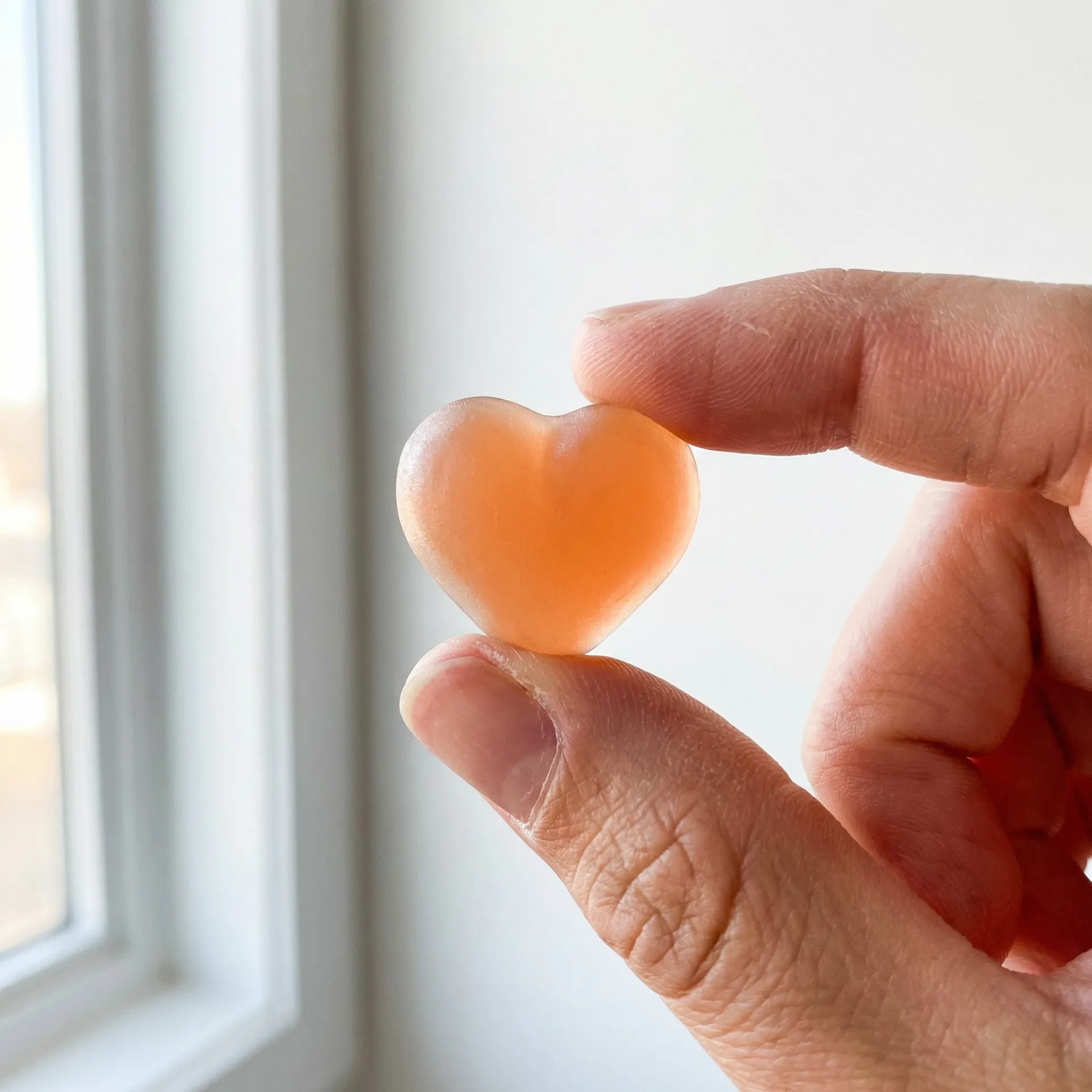
One gummy. Once a day. That's it.
Why I Made It a Gummy
When I started formulating, every version I built was a capsule protocol. Four capsules a day. Six capsules. Eight. The dosing required to hit therapeutic levels of the key compounds — ashwagandha KSM-66, saffron extract, DIM, magnesium glycinate, B6 in its active form — was significant.
And then I watched Claire forget to take her capsules for the fourth day in a row.
She wasn't being careless. She was exhausted and foggy and managing two kids and a job and a marriage that was under enormous strain. A four-capsule protocol at two different times of day was never going to be something she'd do consistently. And consistency is everything with this kind of support — the neurochemical stabilization only works if you're building it up daily.
So I reformulated. One gummy. Once a day. Heart-shaped, peach-colored, tastes like something you'd actually want to eat. Not because I was trying to make it cute — because I needed Claire to take it every single day without it feeling like another thing on her list.
The bioavailability in a well-formulated gummy is actually superior to capsules for several of these compounds because the lipid matrix improves absorption. It wasn't a compromise. It was the right delivery system.
What Happened When Claire Started Taking It
I want to be honest about the timeline because I think a lot of supplement marketing sets unrealistic expectations. Claire didn't feel different in three days. She didn't wake up on day seven feeling like herself again.
At about day 10, she told me the rage episodes were shorter. Still happening, but shorter. Less intense. She could feel herself coming back from the edge faster.
At week three, she called me on a Tuesday afternoon. She'd just laughed at something her daughter said. Actually laughed — not a polite smile, not going through the motions. A real laugh that surprised her.
"I forgot what that felt like," she said. And then she started crying. Good crying. The kind that means something is coming back.
By week six, the flat grey nothing was gone. Not replaced by some artificial happiness — replaced by her. The actual her. The one who cried at movies and got excited about things and felt love the way she used to feel it.
"I feel like I got my sister back. And she told me she feels like she got herself back. That's the only metric that matters to me."
Claire and me, six weeks later. This photo still makes me cry.
65,000 Women Later
I started RYVIVE because of Claire. I kept building it because of the 65,000 women who've told us versions of the same story since.
The woman who said she'd been apologizing to her kids for two years before she understood what was happening to her brain. The woman who told us she'd stopped going to her book club, her yoga class, her best friend's birthday dinner — not because she was sad, but because she felt nothing and couldn't explain that to anyone. The woman who said she'd started to believe this was just who she was now.
It's not who you are. It's your estrogen doing something to your serotonin and dopamine that nobody warned you about and nobody is treating.
The rage isn't you. The emptiness isn't you. The whiplash between them — that terrifying cycle of screaming and then feeling nothing — is a neurochemical event that has a name and a mechanism and, now, a solution that fits in the palm of your hand.
"I thought I was just becoming a bitter, empty person. I'd accepted it. I'd started to grieve the version of me that used to feel things. RYVIVE didn't just help my symptoms — it gave me back the belief that I was still in there."
— Melissa, 41 — Ohio
"The rage was destroying my marriage. My husband was walking on eggshells. My kids were scared of me. I was scared of me. Within a month of starting RYVIVE I felt the anger lose its grip. I can't describe what that's worth."
— Sandra, 44 — Texas
"I didn't even realize how numb I'd become until I started feeling things again. I cried watching my son's school play. Properly cried. I hadn't done that in two years. My husband didn't know what to say. Neither did I."
— Jo, 46 — Colorado

If you recognize yourself in what I've described — the rage that comes from nowhere, the emptiness that replaces it, the exhausting cycle of feeling too much and then feeling nothing — I want you to know that what you're experiencing is real, it has a cause, and it's not permanent.
RYVIVE is what I built for Claire. One heart-shaped peach gummy a day, formulated specifically to address the estrogen-serotonin-dopamine cascade that drives both the rage and the numbness. Not a mood stabilizer. Not an antidepressant. A daily foundation that gives your brain what it needs to regulate itself the way it's supposed to.
I built it from women, for women. Because I watched what happens when a woman doesn't get the support she needs — and I wasn't willing to let that be the end of my sister's story.
It doesn't have to be the end of yours either.
One gummy. Once a day. Built by a woman who needed it to work.
RYVIVE™ is the only daily gummy formulated specifically for the estrogen-serotonin-dopamine cascade that drives perimenopause rage and emotional numbness. Heart-shaped, peach-flavored, and backed by a 60-day money-back guarantee — because I know what it's like to have spent money on things that didn't work.
If it doesn't give you back something you thought you'd lost, you don't pay for it. That's my promise. From a woman who built this for her sister.
Free shipping · 60-day money back guarantee · Made for women, by women